

Invite Only
LinkShift
One QR code, printed once, that changes where it points on a schedule you set — for menus, badges, packaging, and signage you can't reprint.
At a glance
- One QR code, printed once, whose destination changes on a schedule — for the things you can’t reprint: menus, badges, packaging, signage.
- Time-based rules (daily or weekly windows, real timezones, priorities, conflict detection) decide where a scan lands right now — with a preview of where it’d go at any hour.
- Scan analytics that count people, not bots — by hour, by rule, by place and device, exportable.
- An MCP server, so you can literally ask an agent to manage your codes. Plus a real API and webhooks.
The flowlink detour
In the summer of 2025 I started building with AI in earnest, and I got fixated on go-links — those tidy internal shortcuts — except I wanted to go deeper than a plain redirect. Somewhere in there I discovered the .ing TLD and, after some back-and-forth with Claude, registered flowlink.ing.
I built it out into a full branded short-link platform: custom domains, folders and tags, A/B tests, campaigns, UTM templates, retargeting pixels, click analytics, an API and webhooks — and the part I actually cared about, rules that let a link change where it points over time. Then I learned a little about Cloudflare Workers and realized I could design the rules in my app and periodically deploy them into a very fast Worker running at the edge. Clever. But it’s a crowded space, and I couldn’t convince myself my ideas were different enough to matter. So it sat.
A Friday-night speed run
Then, on a Friday night — the second time I’ve done this lately — I had a pile of AI tokens about to be lost to a 5am Monday reset. Rather than waste them, I decided to speed-run one carved-out slice of flowlink.ing, and use it to try a stack I don’t normally reach for: shadcn design tokens with React components on InertiaJS. (I’m a Hotwire guy.) Twenty-four hours later I had a genuinely viable little SaaS, pointed at one thing: a QR code whose destination changes on a schedule.
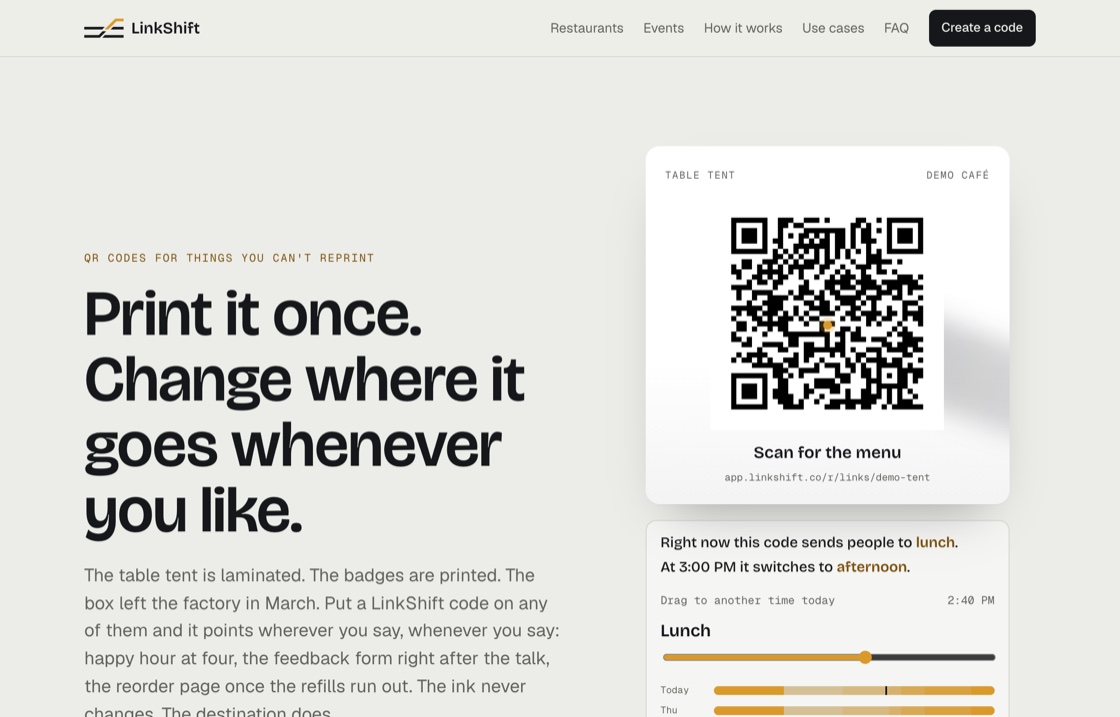
The example that makes it click: a restaurant prints a menu QR on a tabletop tent — once — and that same code renders the breakfast, lunch, or dinner menu depending on the time of day. The tent never changes. The link does.
What it does
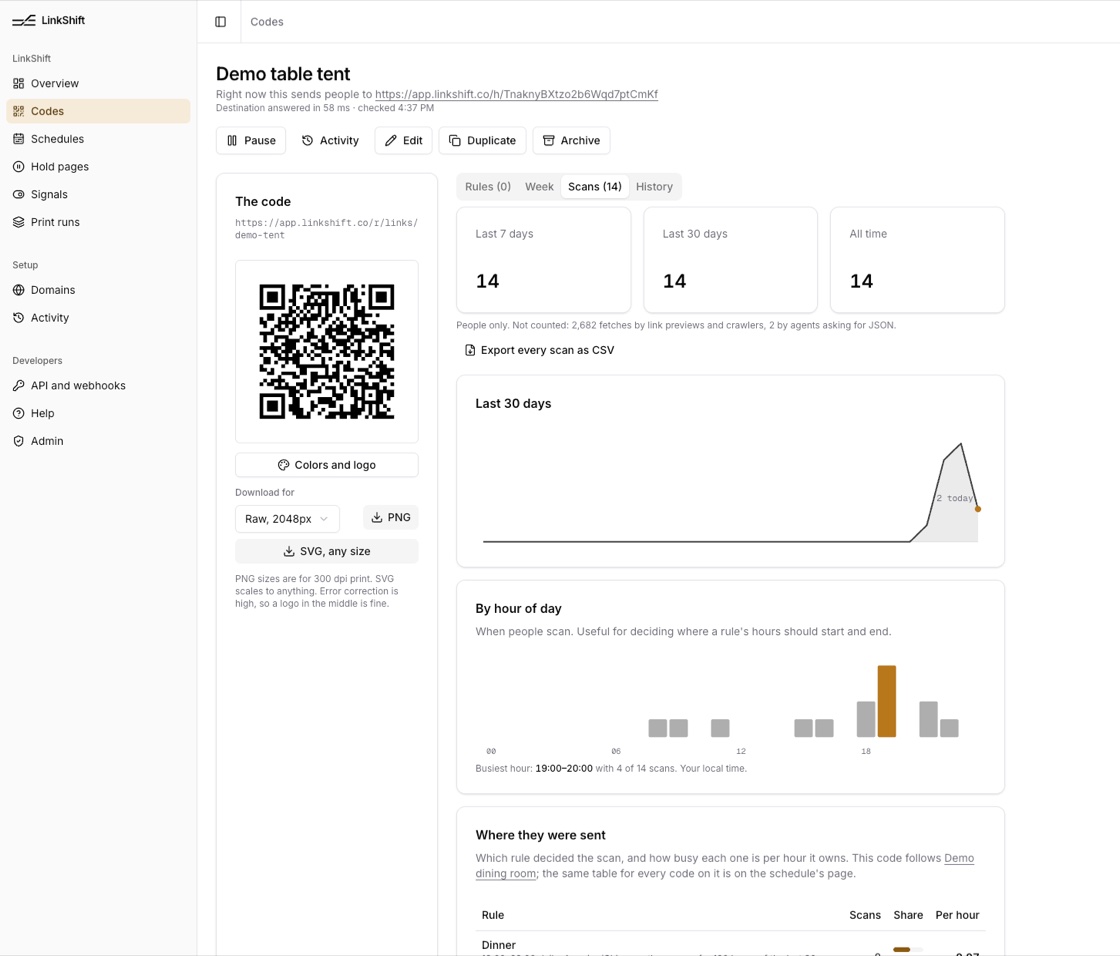
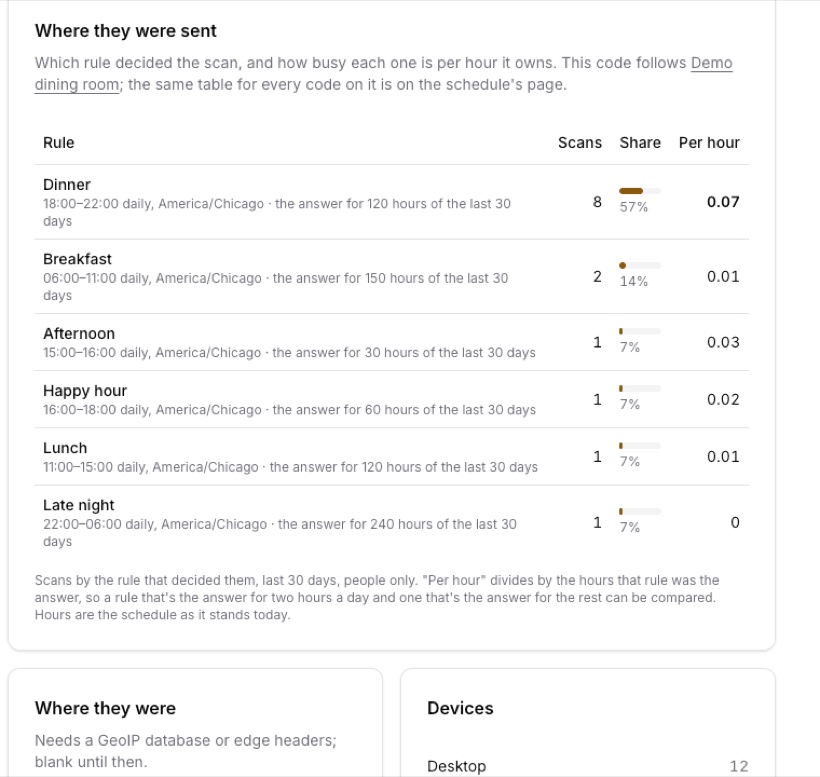
Every code answers a 302 with wherever it points right now — never a 301, because the whole product is that it moves. You build the schedule out of rules: bounded or open-ended windows, daily or weekly, in a real timezone, with priorities and conflict detection when two rules overlap. A preview tells you where a scan would land at, say, 4pm Friday. And then it measures — by hour, by rule, by place and device, exportable as CSV or through the API.
Under the hood
There’s no real AI in this one — beyond the fact that AI generated the code, and the MCP server I built into it, which means you can ask an agent to manage your codes. (Which is genuinely fun.) I registered linkshift.co, built a Jekyll marketing site, and deployed the app alongside the rest of my fleet. ChatGPT gave me logo concepts; Claude’s design tool refined the design system and produced the assets.
An honest note
It’s invite-only for now, while I figure out how — and whether — to go find customers and compete with more ambitious incumbents.